


Heteroglossia: Languages and Translation
Programmed by: Aaryan Kumar
Coined by Russian literary theorist Mikhail Bakhtin, heteroglossia (from Greek: hetero - “different” and glōssa - “tongue, language”) refers to the stratification within a language of several competing discourses, such as regional dialects, professional jargon, the vocabularies of particular ideologies. Bakhtin identified the novel’s defining characteristic as its variedness in discourse: where epic poetry works to unify language into a single coherent voice, the novel manages heteroglossia. It additionally “novelizes” preceding genres and discourses, not unlike the way film has long metabolized the novel and the stage into something formally its own. As such, exploring the heteroglossic in film can involve a careful study of auteurist influences, an understanding of preceding mediums, and more. This series takes a more direct interest in cinema as a multi-lingual affair of spoken language; Bakhtin distinguishes this as the polyglossic, or the co-existence of genuinely different national languages. And though there is a distinction to be made between polyglossia and heteroglossia — the former a precondition for the latter — a film can be treated as its own kind of single discourse, one in which the coexistence of separate languages onscreen becomes a stratifying force within the film’s own unified voice.
The presence of several languages in a film can surface the anxieties of a nation-state and its possibility, as with Mandabi. Elsewhere in Drive My Car, it is a mode of thinking about alterity between people. Indeed, a film can and has privileged one voice over another. As the experience of film, especially international arthouse film, is so often mediated via translation, this series invites the consideration of whether these texts can be heteroglossic or polyglossic.
The New World (2005)

Terrence Malick · 151m · 35mm
Working closely with linguist Blair Rudes to recreate the extinct Powhatan language, Terrence Malick renders the 1607 settlement of Jamestown by English colonists in epic form. The clash of languages and star-crossed romance of Pocahontas and John Smith resemble the Aeneid, while elsewhere Mozart and Wagner are drawn on for inspiration. Yet Malick maintains a distance from the traditions he inherits, simultaneously inhabiting and critiquing these modes and the brutal conquest of the continent.
Thursday, October 1 6:00 PM
Hill of Freedom (2014)

Hong Sang-soo · 66m · DCP
Mori, a lovelorn Japanese schoolteacher travels to Seoul to confess his love to a long-lost partner, Kwon, only for her to be nowhere to be found. He visits a nearby cafe and writes letters to her every day. When Kwon returns from her stay in the mountains, she drops the stack of undated letters and must make sense of their chronology and Mori’s feelings.
Thursday, October 8 7:00 PM
Drive My Car (2021)

Ryusuke Hamaguchi · 179m · DCP
Two years after his wife’s sudden death, a renowned stage actor directs a multilingual production of Chekhov’s Uncle Vanya. He refrains from casting himself as the titular Vanya, hoping to avoid the unresolved emotions the play surfaces as he mourns. The pressurized interiors of a car and the open air of a stage serve as the domains for honesty and redemption.
Thursday, October 15 6:00 PM
Mandabi (1968)

Ousmane Sembène · 92m · DCP
The first-ever feature film in Wolof or any African language, Mandabi (The Money Order) was a milestone in Sembène’s oeuvre of anti-colonial filmmaking. A derelict, middle-aged man receives a money order that should help him repay his numerous debts, but with no proof of identification and unable to speak French, he must struggle his way through the Senegalese bureaucracy.
Thursday, October 22 7:00 PM
Certified Copy (2010)

Abbas Kiarostami · 106m · DCP
British writer James (William Shimell) makes a stop in Tuscany to promote his latest book, Certified Copy, which argues that originality is irrelevant in art since all original art is a reproduction. He meets Elle (Juliette Binoche), and they spend the day together, speaking English but occasionally drifting into French. As the pair debates the merits of authenticity, the film eerily resembles Summertime and Before Sunrise.
Thursday, October 29 7:00 PM
Touki Bouki (1973)
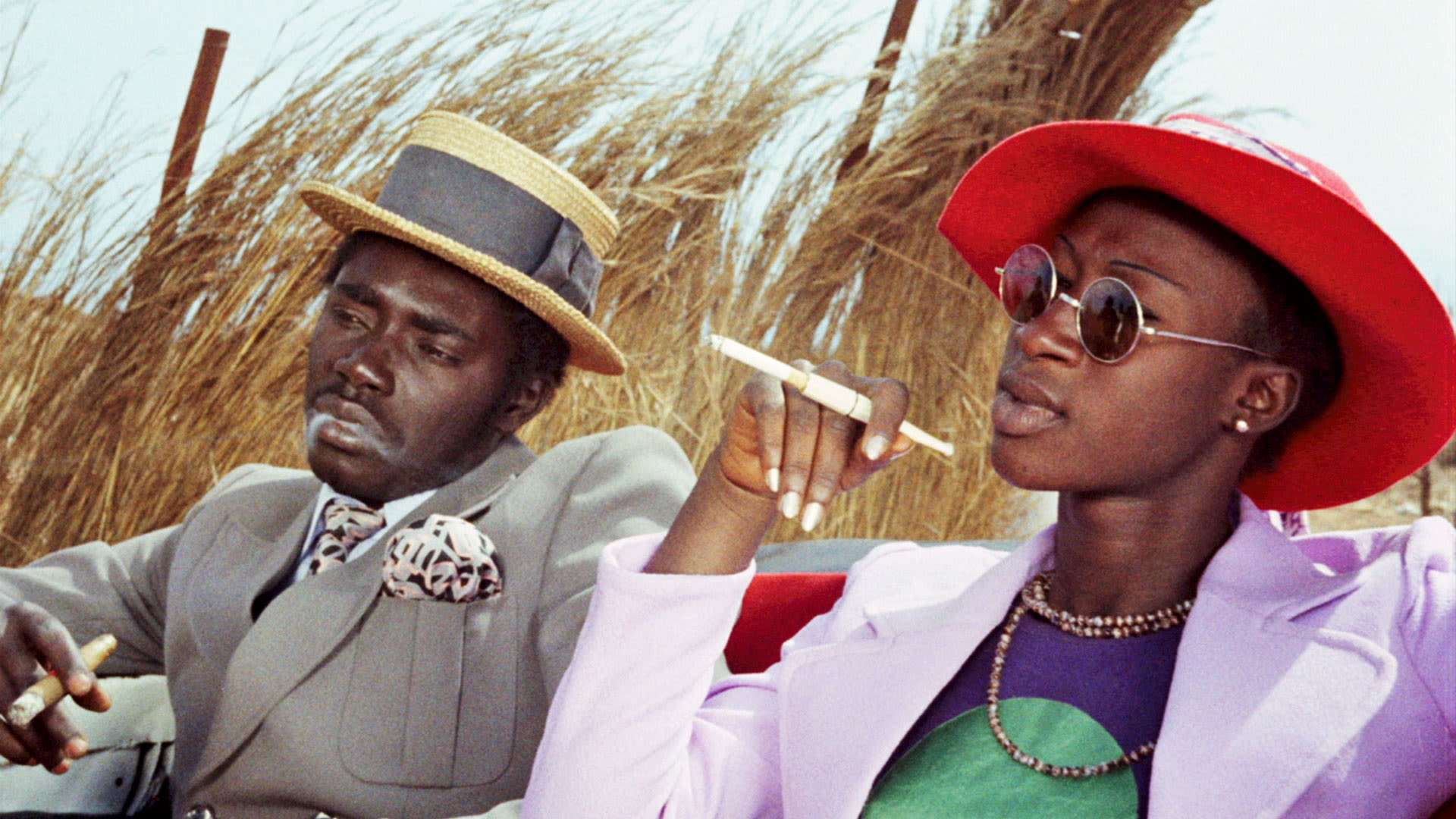
Djibril Diop Mambéty · 91m · DCP
A young Senegalese couple dreams of leaving Dakar for Paris, attempting several burglaries to raise funds for their ticket. Evocative of the French New Wave, while drawing on Wolof folklore, imagery of the American dream, and repeated invocations of Josephine Baker, Touki Bouki is a polyphonic experience fueled by what Martin Scorsese describes as a “raw, wild energy.”
Thursday, November 5 7:00 PM
Poto and Cabengo (1979)

Jean-Pierre Gorin · 77m · Digital
Identical twins Grace and Virginia Kennedy suffered seizures shortly after birth. Raised by a German-speaking grandmother, the girls (who nicknamed themselves Poto and Cabengo) developed a quick-paced private language incorporating several Anglo-German neologisms. Director Jean-Pierre Gorin explained, “[t]he film is about an unstructured discourse — the language of the twins — surrounded by structured discourses — the discourse of the family, the discourse of the media, the discourse of therapy, the discourse of documentary filmmaking.”
Thursday, November 12 7:00 PM
Goodbye to Language (2014)

Jean-Luc Godard · 69m · 3D DCP
“The idea is simple / A married woman and a single man meet / They love, they argue, fists fly / A dog strays between town and country / The seasons pass / The man and woman meet again / The dog finds itself between them / The other is in one, / the one is in the other / and they are three / The former husband shatters everything / A second film begins: / the same as the first, / and yet not / From the human race we pass to metaphor / This ends in barking / and a baby’s cries / In the meantime, we will have seen people talking of the demise of the dollar, of truth in mathematics and of the death of a robin.” - JLG
This film will be screened in 3D at the Logan Center Screening Room, 915 E 60th St.
Thursday, November 19 7:00 PM
I Dream in Another Language (2017)

Ernesto Contreras · 101m · DCP
A Mexican linguist travels to the rainforest of Veracruz to document and study a dying Indigenous language. He learns that its last two speakers had a falling-out and refuse to communicate with one another. Similar to the first film in this series, The New World, director Ernesto Contreras worked closely with a linguist not to recreate an Indigenous language, but to invent an entirely new language, Zikril, for the actors to speak.